
Summary
This research explores whether eye movements and bicycle motion can reveal how hard a cyclist is working when balancing — especially when riding with hands off the handlebars.
| Theme | Bicycle Engineering | Current Researchers | |
| Last Worked On | November 2025 | Past Researchers | Jules Ronné |
| Collaborators | Holger Caesar, Jason K. Moore |
Products
Jules Ronné, Holger Caesar, Jason K. Moore (2025). “Inferring cyclist workload using gaze metrics for bicycle balancing tasks.” Congress of the International Society of Biomechanics (ISB 2025), Stockholm, Sweden.
Description
Motivations
Riding a bicycle — especially in a busy city — requires constant attention and effort. This study focuses on a specific situation: when a cyclist rides with their hands off the handlebars. This makes balancing harder and increases mental load. The goal is to find out whether we can detect this extra effort using simple measurements — like how the eyes move or how the bike wobbles.
Data collection
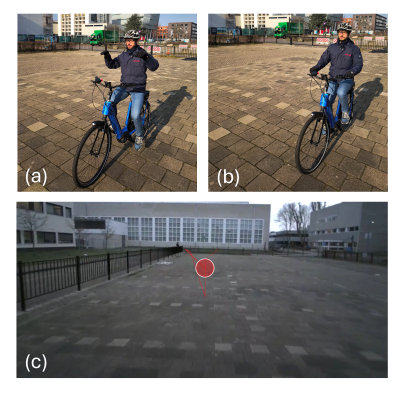
The experiment used a regular electric bike equipped with sensors to track its movement. The rider wore special glasses that record where they look — including how often they blink, fix their gaze, or shift their eyes quickly. Two situations were tested: riding normally (hands on the handlebars) and riding with hands off. The rider kept a steady speed and went straight ahead in both cases.
Analysis
Researchers compared how the bike moved and how the rider’s eyes behaved in both situations. The idea was to see if changes in eye behavior — like how long they look at one spot or how big their pupils get — match up with the extra effort needed to balance without hands.
Main results
When riding with hands off, the bike wobbled more — which makes sense, since it’s harder to stay upright. At the same time, the rider’s eyes showed signs of higher mental load: they looked longer at fixed points, and their pupils got slightly larger. These changes suggest that eye tracking could be a useful way to estimate how hard a cyclist is working — even without asking them directly.
In short, simple eye and bike measurements may help us understand what’s going on in a cyclist’s mind while they ride — especially when they’re trying to balance without using their hands.
Funding
This 12 months postdoc project was funded by a cohesion grant of TU Delft between the Intelligent vehicle group (Cognitive Robotics department) and the Bicycle Lab (BioMechanical Engineering department).