

Summary
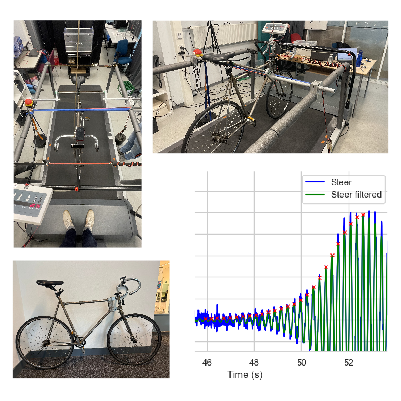
This study develops a controlled experimental platform to investigate how component stiffness influences bicycle dynamics — particularly the stability of intrinsic vibration modes, including the well-known wobble mode — using a parametric bicycle on a stabilized treadmill.
| Theme | Bicycle Engineering | Current Researchers | |
| Last Worked On | November 2025 | Past Researchers | Jules Ronné, Benjamin Gonzalez, Jason K. Moore |
| Collaborators | Roy Peters, Harm Verhoeff, Koen Gesthuizen, Bas Willemsen, Tim Bosman |
Products
Bachelor End Project Report
- Peters, R., Verhoeff, H., Gesthuizen, K., Willemsen, B., & Bosman, T. (2025). Examining wobble of a bicycle on a stabilized treadmill setup. Bachelor End Project, Mechanical Engineering, Delft University of Technology. Supervised by Jules Ronné, Benjamin Gonzalez, and Jason K. Moore.
Acknowledgement
The student team is commended for their excellent technical execution, thoughtful experimental design, and clear contribution to the methodological advancement of bicycle dynamics research.
Description
Motivations
Bicycle dynamics — particularly their tendency to exhibit unstable vibration modes such as wobble — is strongly inner controlled, repeatable conditions. This project aims to fill that gap by developing a stabilized treadmill-based test setup paired with a parametric bicycle, enabling targeted investigation of how stiffness modulates the stability of intrinsic dynamic modes — including wobble influenced by the stiffness of structural components. Wobble, characterized by oscillation of the front assembly about the steering axis, is a well-documented instability that can compromise safety and handling. While prior bicycle research has explored (mostly) numerically its dependence on geometry, tire properties, and rider effect, few studies have systematically isolated the effect of component stiffness.
Data collection
A custom parametric bicycle — featuring adjustable frame geometry (top tube, fork length, steering and fork angles) and tunable structural stiffness — was mounted on a stabilized treadmill to eliminate rider-induced variability. Synchronized gyroscopes were mounted on the front assembly to capture rotational motion. Tests were conducted at low velocities across multiple stiffness configurations, allowing direct observation of how changes in rigidity affect modal behavior.
Analysis
Recorded motion signals were analyzed using signal processing and linear stability methods. The stability and frequency of dominant modes — notably the wobble mode — were evaluated as functions of stiffness and velocity. Statistical validation was performed via ANOVA to assess the significance of observed trends. The goal was to establish a reliable, repeatable framework for studying how component-level properties shape global vehicle dynamics.
Main results
Two distinct vibration modes were identified, both occurring at lower frequencies than typically reported — consistent with the reduced stiffness and lower test velocities employed. Crucially, the relationship between stiffness, velocity, and mode stability aligned with theoretical expectations: increased stiffness and/or velocity tended to stabilize the wobble mode, while lower values promoted instability. The treadmill setup proved highly effective in enabling controlled, rider-free experimentation — offering a robust platform for future parametric studies of bicycle dynamics.
This work provides a foundational methodology for investigating how component stiffness shapes the stability of intrinsic dynamic modes — a critical step toward designing safer, more predictable bicycles.
Funding
This project was conducted as part of the Bachelor End Project program in the Mechanical Engineering department at Delft University of Technology. This project was funded by a cohesion grant of TU Delft between the Intelligent vehicle group (Cognitive Robotics department) and the Bicycle Lab (BioMechanical Engineering department).